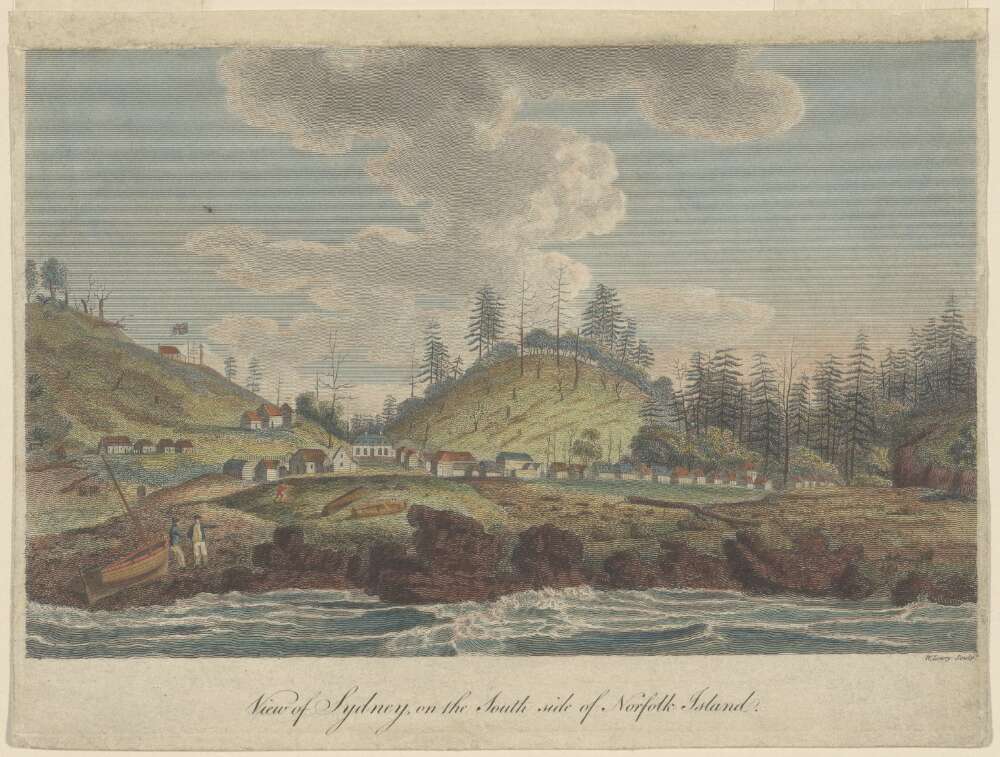
Cover: Lowry, Wilson & Collins, David (1798). View of Sydney on the south side of Norfolk Island.
National Library of Australia.
Uncovering Norfolk Island
the Archives and Archaeology of the First British Settlement (1788-1814)
Welcome to the Archive
Explore the lives of the convicts, soldiers, and settlers who shaped the history of Norfolk Island.
Database ID
Life Timeline
📚 Source Records
About the Project
This web portal represents a digital evolution of the Directory of the Norfolk Island First Settlement, 1788-1814 (Roberts & Dunn, UNE, 2024). Expanding on the groundbreaking original work which catalogued 3,650 individuals, this application now allows users to view the primary source records detailing their lives. The system assigns a unique alphanumeric identifier (UID) to each person, enabling records from over 100 source documents to be directly linked to specific individuals.
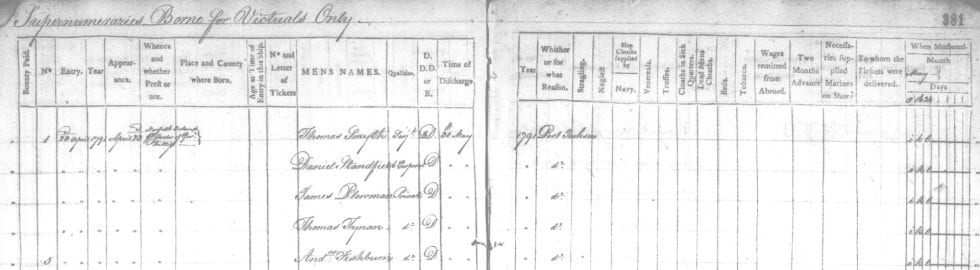
Extract from the Royal Navy Ships Musters for the Supply, Port Jackson to Norfolk Island on March 1790, recording the mustering of supernumeraries, in this case Marines from 'The First Fleet'.
Through rigorous cross-referencing of digitised spreadsheets, researchers have corrected previous misidentifications—such as ship misattributions—and applied specific naming conventions to maintain integrity. Individual names are rendered using the most consistent spelling (SURNAME / FIRSTNAME), while numerals in parenthesis, e.g., JONES WILLIAM (2), are used to distinguish multiple individuals with the same name. This granular approach ensures distinct adults and children are accurately separated rather than conflated.
To handle historical ambiguity, the project incorporates specific syntax. The symbol (+) is appended to a name where records are insufficient to distinguish between known individuals, or where a document lists only a surname. This acknowledges the limitations of the paper trail—such as damaged documents or generic entries like ‘convict’s child’—while preserving the data point for future analysis.
Acknowledgements
In making this project possible, we acknowledge the Australian Research Council and the University of New England (NSW), and our project partners at the Universities of Queensland and Southern Queensland, University College London and the Kingston and Arthur's Vale Historic Area. We especially acknowledge the many students and volunteers who contributed to this work, including Cathy Dunn of Australian History Research.